

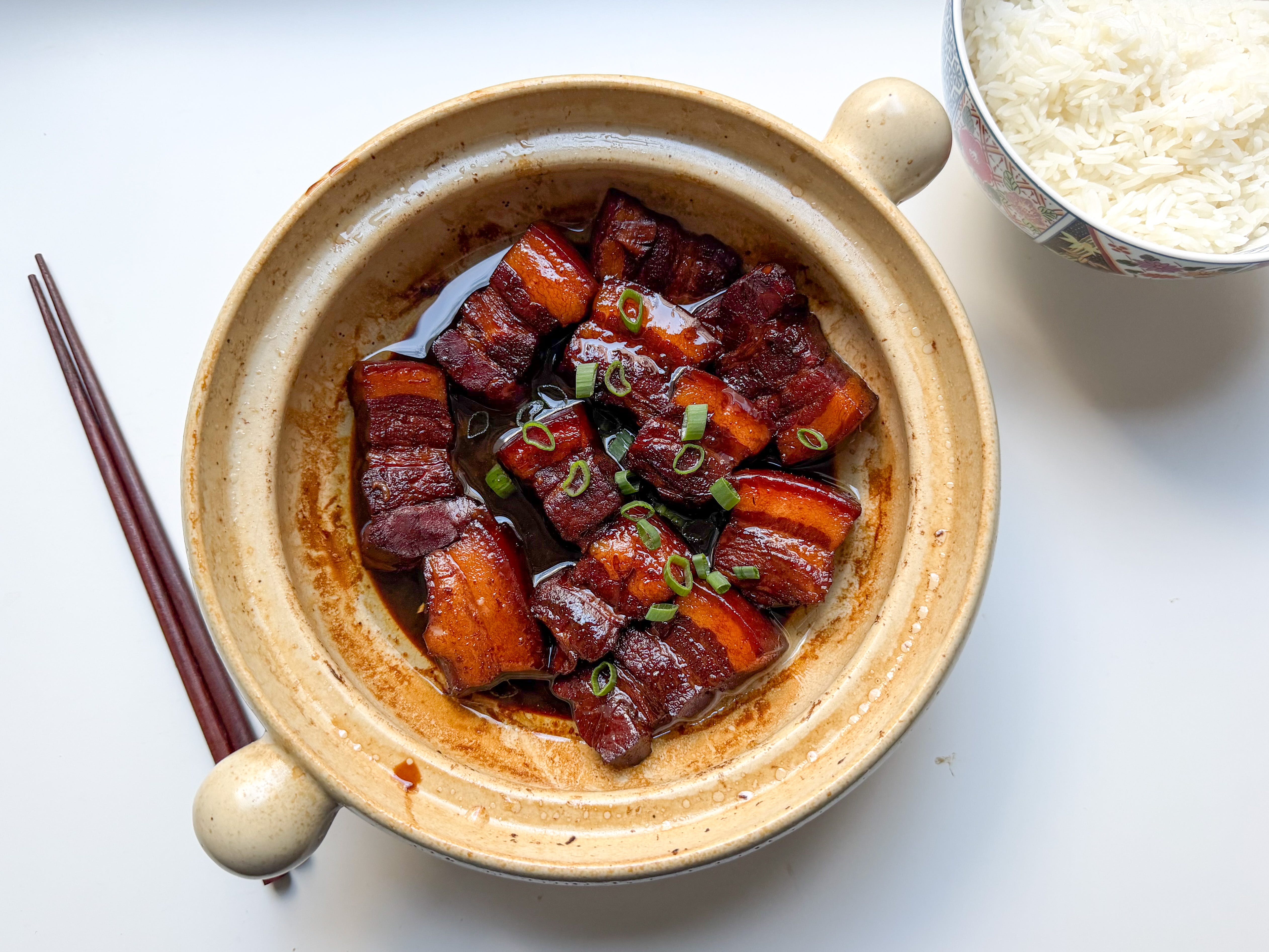
There’s no better way to understand the deep aroma of Shaoxing wine than by cooking hong shao rou (红烧肉), red-braised pork belly. It also explains a few other things: China’s long-standing love of pork and its use of two types of soy sauce.
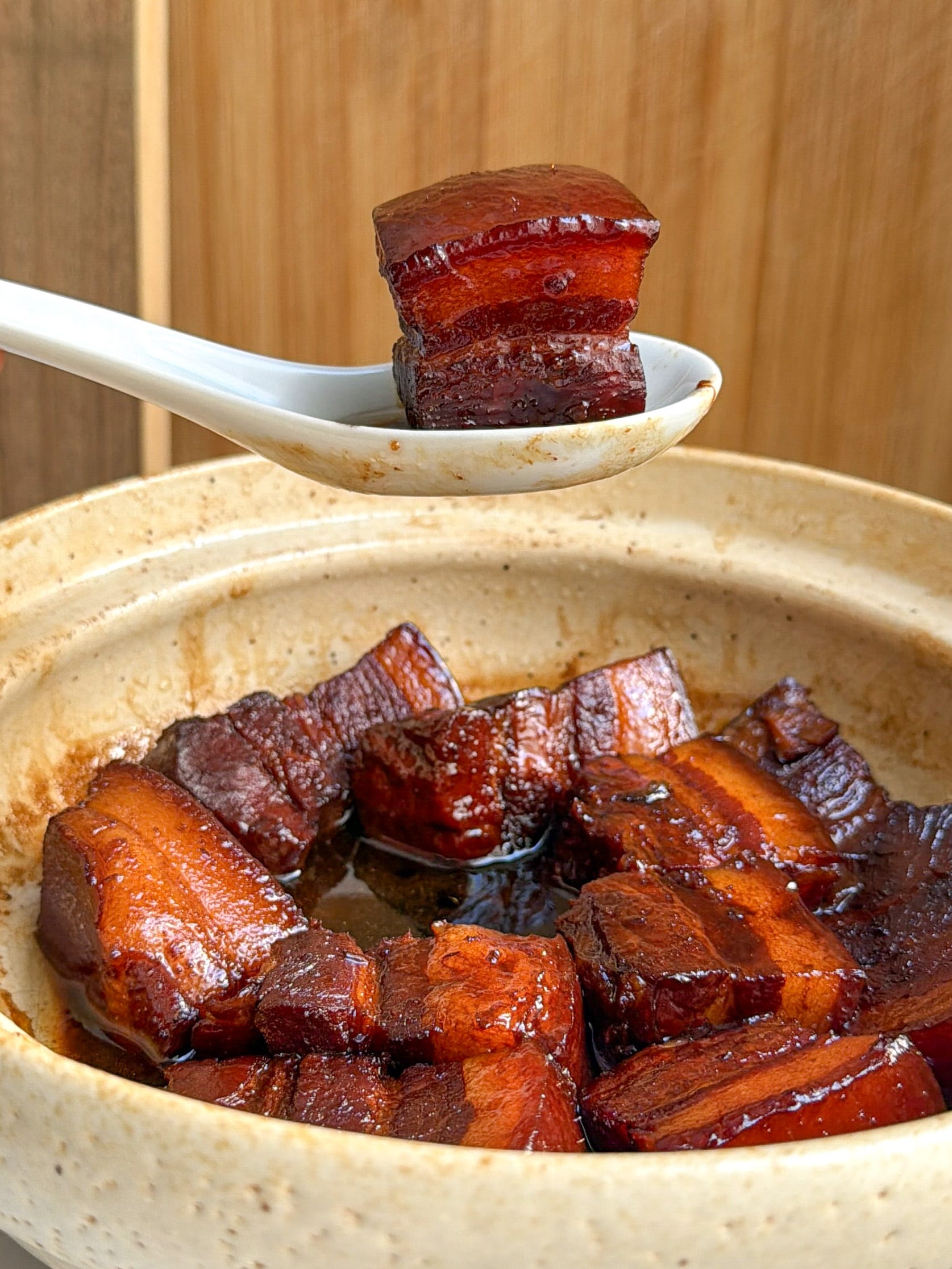
And even if you’re not looking for explanations, it’s hard to argue with a piece of well-marbled, amber-colored pork belly that jiggles on the spoon. It’s a showstopper on any Chinese table, the kind of dish that feels both everyday and special.
The Story of Dong Po Rou
To understand hong shao rou, it helps to start with its better-known relative, or possibly its ancestor: dong po rou (东坡肉). The dish is named after Su Dongpo (苏东坡, aka 苏轼), a Song dynasty poet, official, and enthusiastic eater. While living in Huangzhou in Hubei, he noticed that pork was cheap but underappreciated. So he wrote Ode to Pork (猪肉颂), part poem, part cooking advice:
净洗铛,少著水,柴头罨烟焰不起。待他自熟莫催他,火候足时他自美。 黄州好猪肉,价贱如泥土。贵者不肯吃,贫者不解煮,早晨起来打两碗,饱得自家君莫管。 Wash the wok thoroughly, add a bit of water, and use low heat to cook it. Wait patiently until it’s cooked through. When the time and heat is right, it will naturally taste good. Huangzhou’s pork is excellent, and the price is practically nothing. The rich won’t eat it; the poor don’t know how to cook it. Every morning, I eat two bowls of it, perfectly satisfied.
What’s less clear is which cut he used and how he seasoned it.
According to a 40-page study, “The Invention and Spread of Dongpo Pork” by Professor Wu Jen-Shu (巫仁恕) of National Chengchi University of Taiwan, the name “dong po rou” didn’t appear until the Ming dynasty, about 500 years later. In the Ming and Qing dynasties, it had become a banquet dish among scholars and the elite class to honor the poet’s legacy.
Preparations for dong po rou and similar dishes showed up later, in the mid-Qing dynasty, in books like Suiyuan Shidan (随园食单, English translation known as The Way of Cooking), which includes 3 ways to make red-braised pork (hong wei rou, 红煨肉), with sweet flour sauce, with soy sauce, or with salt and wine.
Tiao Ding Ji (调鼎集) includes several versions of dong po rou, one close to the modern preparation: blanch the pork, make sugar caramel, and then braise the pork with soy sauce, wine, and rock sugar, though it also uses mountain yam and star anise1.
So, is it a Hangzhou dish?
Dongpo pork is now closely tied to Jiangnan cuisine, especially Hangzhou. The popular story is that locals gifted Su Dongpo pork and wine after he helped dredge West Lake. He had it cooked his way and shared it back.
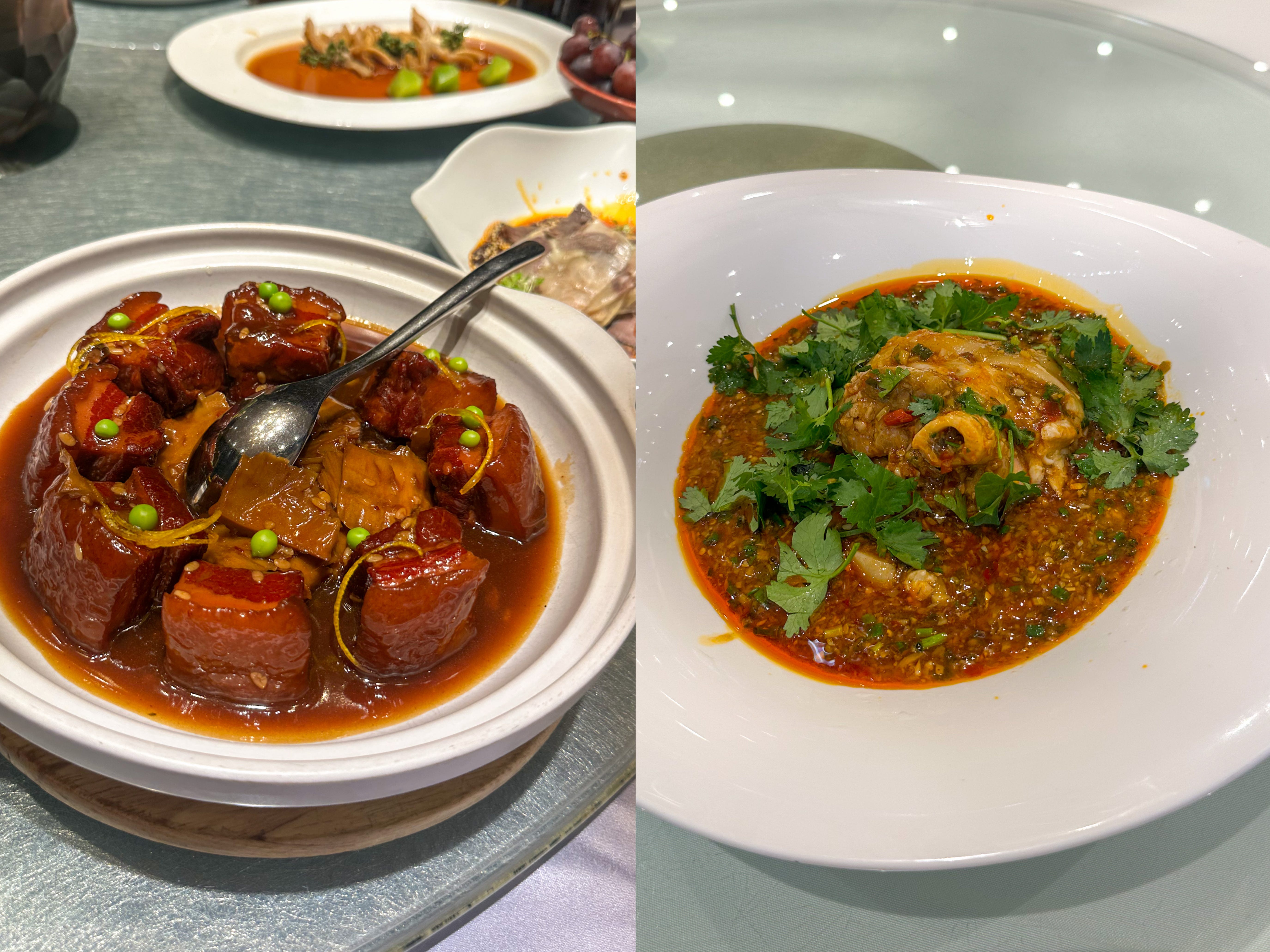
It’s a good story, but there’s no solid evidence for it. Wu argues it’s likely marketing: Hangzhou restaurants began promoting the dish in the early 1900s, especially in Shanghai, branding it as a local specialty. That said, Su Dongpo did spend significant time in Hangzhou, and the city’s chefs have clearly mastered the dish, so the association isn’t entirely undeserved. However, don’t feel so offended if you find a Sichuan restaurant serving it.
Su Dongpo wrote about more than just pork. He celebrated seasonal foods too, including a delicate fish called daoyu (刀鱼), which I once had the chance to try in Shanghai in a wonton dish. Today, “Dongpo” dishes appear across China, especially in places where he lived and worked, from Sichuan and Hubei to Zhejiang and even Hainan, each with its own style. You might even follow in his footsteps and eat your way through the country, as Lin Weihui does in Su Dongpo’s Food Map (《苏东坡的美食地图》).
In Meishan, Su’s hometown, I also had a version of Dongpo Zhouzi (pork hock) that leaned toward fish-fragrant flavors, heavy on aromatics rather than sweetness.
Dong Po Rou vs. Hong Shao Rou
Wang Zengqi, a novelist and fellow gourmet, in the tradition of Yuan Mei and Su Dongpo, wrote in a 1992 essay that “Dongpo rou is essentially just hongshao rou,” and recommended using a generous amount of Shaoxing wine2. Chef Pan Yingjun takes a slightly different view, suggesting that hongshao rou is a later rendition of Dongpo rou and hong men rou, which became popular during the Republican era.
In a 1930s recipe book titled Secret Recipes (秘传食谱), there are five versions of hong men rou (红焖肉), or red-stewed pork. One is nearly identical to modern hongshao rou: it uses pork belly (preferably with three layers), water, Shaoxing wine, salt, and both light and dark soy sauce. The author offers a simple guideline: “Use 80% water and 20% Shaoxing wine… The meat should be amber-colored and lose its sharp edges in shape.” 3 In the same book, Dongpo rou is prepared as a whole piece, first grilled, then stewed for hours until it reaches a tofu-like softness.
In the last few decades, the line between the two is blurry. In my opinion, dong po rou usually refers to a large, neat block of pork, often tied and slow-braised for hours or even half a day. It’s typically served with greens underneath and leans toward banquet presentation.
Hong shao rou is more flexible. It can be home cooking or from a restaurant, rustic or refined. You’ll find regional variations everywhere: Hunan’s Chairman Mao’s Hongshao rou (毛氏红烧肉), which uses dried red chilies, Fujian’s variation with red rice yeast (红糟肉), and Shaoxing’s variation with fermented mustard greens (梅干菜红烧肉).
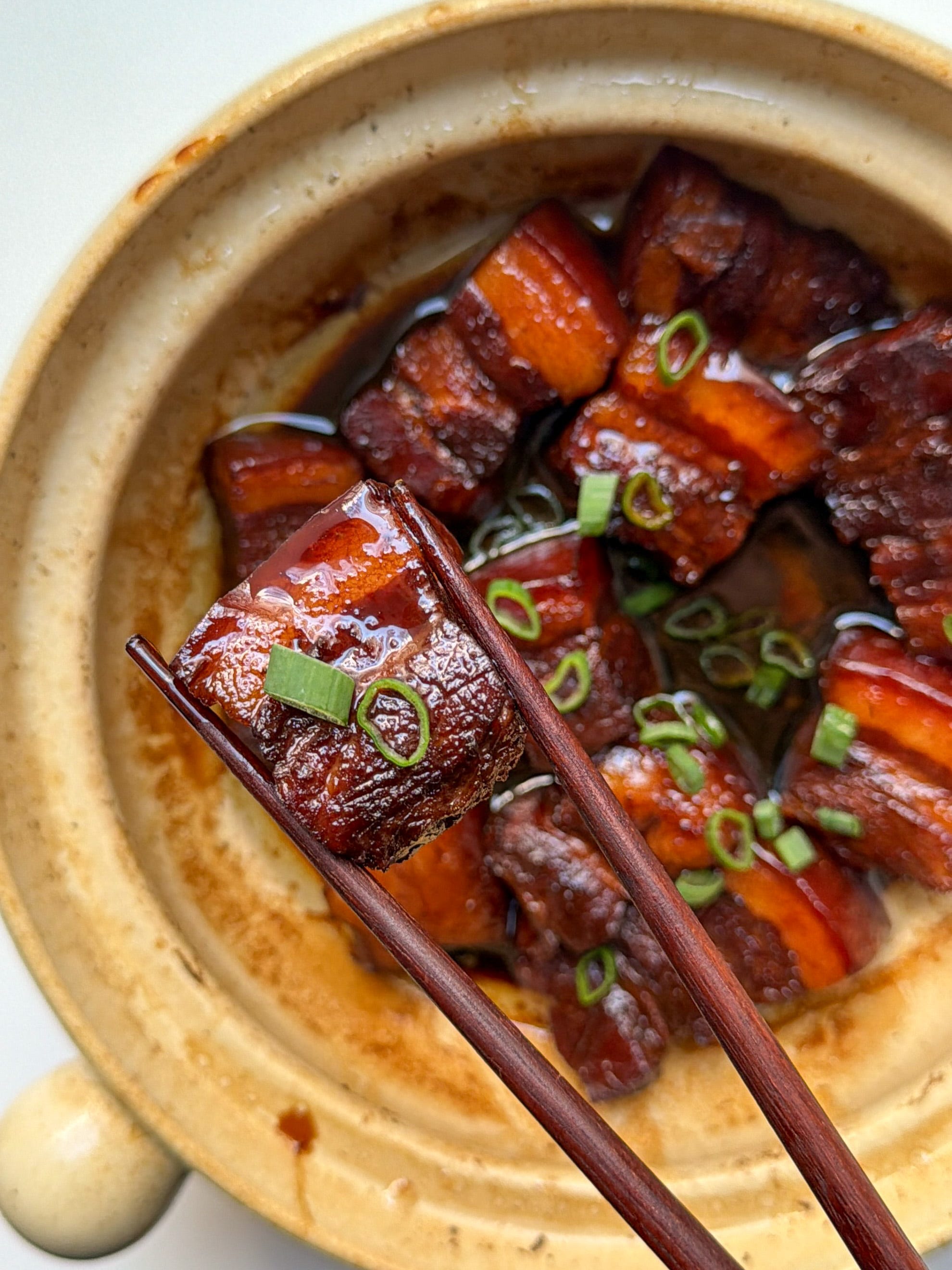
Even if the details have changed over time, Su Dongpo got one thing exactly right: this dish rewards patience. Long, gentle cooking breaks down the meat, softening both the fat and the lean layers into something tender and glossy. Then it melts in your mouth.
Recipe: Red-Braised Pork丨红烧肉 (Hong Shao Rou)
Serves 4
